A place to gather and share information about the Thomas Willcox and Elizabeth Cole Willcox Family of Ivy Mills, PA. For more information see the Home page link above or contact Deniane Kartchner at Denianek@gmail.com. My husband is a descendant of Thomas and Elizabeth's son James who married Prudence Doyle. Their son John's daughter Prudence married John Christopher Kartchner.

Note: This is a work in progress! I am trying to verify everything before I post, but feel free to send me corrections and/or suggestions. It’s also not a complete history of Ivy Mills or a website for current operations, although I will gladly try to answer any questions and/or lead you to the right information.

I'm currently working on tracing this family back to England through this link:

http://discovery.nationalarchives.gov.uk/

Showing posts with label Prudence Doyle. Show all posts

Birth date discrepencies


In 1904, Joseph Willcox  wrote a sketch about the Willcox family—including a section about James Willcox and Prudence Doyle. The sketch was published in The Records of the American Catholic Society.


In 1911, he compiled this and several other sketches into a book “Ivy Mills, 1729-1866: Willcox and Allied Families.”


As far as James and Prudence are concerned, there are some interesting differences between the two accounts, mainly in the birth order of the children. In the 1904 account, Ann was born first (1754), John second (1756), and Thomas third (1758). In the 1911 version, however, a different date is given for Ann’s birth (1760), placing her as the third child with John as the oldest.

(Interestingly, a tombstone inscription included in the same 1911 publication says that Ann “departed this life on the 23d of November 1821, at sea, aged 63 years,” which would put her birth date in 1758 and make her two years older than her husband John Cassin, born 1760.)


There are definitely discrepancies in the birth order. Which is correct? (Interesting side note: in Prudence Doyle Willcox (Slater)'s will, she lists her children in the following order: Thomas, John, James, Ann, Elizabeth, Mary and Sibby.) For copy of will click HERE:

Prudence Slater's Will


Here is a copy of Prudence [nee Doyle Willcox] Slater's will. In it she wills her grand daughter Prudence, daughter of her son John, 60 dollars to be given when she is 18 years of age. The executors are Thomas, John, and Mark Willcox.

From my research I know that Thomas and John are her sons; Mark is her brother-in-law. The date of the will is May 1799; Prudence Willcox (later Kartchner) was born in Dec. 1787, so she was 12 years old when Prudence wrote her will. The will was proved in 1801; she would have been 15 by then, so not "eligible" for her inheritance yet. She doesn't give any other grandchild a specific amount....so I have started thinking about their relationship and how they must have been close. She was obviously a favorite, maybe due partly to the shared name...

Here's my thoughts. You would think that Prudence would have received the money easily enough...it would have been in 1805 that she turned 18 and all the executors (or at least John and Mark) were still alive. It's interesting, this matter of an inheritance, because Wm. D. writes that around 1817-1818 his father (John Christopher Kartchner) thought of "entering suit against Mr. Wilcox for his wife's part of an estate in Philadelphia left to his children by Mr. Wilcox" that she apparently hadn't received. Prudence's father died in 1818 and I have not yet found a will. Maybe she was supposed to receive money from her father and never got it. Or, was this the matter of the 60 dollars from her grandmother, still not taken care of? Hmm.

I'm just trying to use this information to look for more documents.

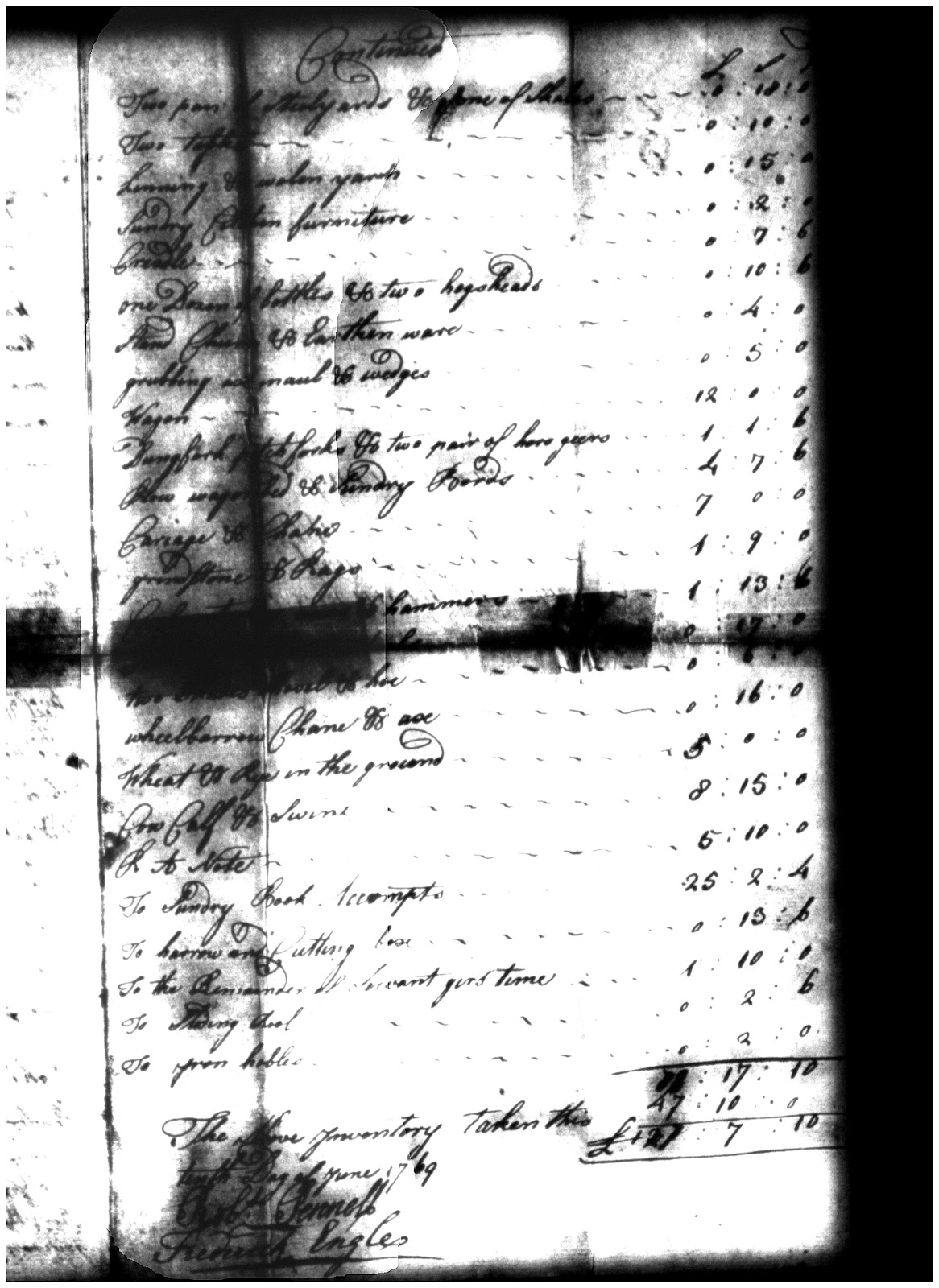
James Willcox estate papers

I found a file with James Willcox's estate papers at the Family History Library in SLC on a microfilm. I will go back and get the exact call number for future reference, but I am posting the copies here so that as I have time I can start transcribing them. What a treasure!!


James and Prudence Willcox Family


i  Ann,3 b. about 1754; m. Capt. John Cassin, of Philadelphia.
ii John,3 b. about 1756; buried 10, 1, 1818; m. Sarah Walton, of Scotland. He was a hatter, and lived and died in Middletown, Del. Co, Pa.
iii Thomas,3 b. 12, 7, 1758; m. (1st) about 1782, Hannah, dau. of Dr. Thomas Worrall, of Chester, now Del. Co., pa. He m. (2d) Catharine King, of same county. He was a papermaker. About 1813 he moved, with his wife, to Columbia Co., Pa.
iv  Mary,3 – b. 6,11, 1763; baptized at St. Joseph’s Church; d. 4, 20, 1820; m. Peter Scravendyke, of Philadelphia.
v Elizabeth,3 – m. (1st) Feb., 1785, Capt. Henry Bicker. She m. (2d) Willliam McMurray, and m. (3d) Thomas Hoggard. She was a widow when she died in Sept, 1802.
vi Sabina (Sibby),3 – m. Robert Webb, of Philadelphia. In 1812 he was a jeweler living in Southwark.
vii James,3 m. _______, Mary ______. He was a paper-maker, and as late as 1822 he was living in Middletown, Del. Co.

James Willcox property in Upper Providence, PA


JAMES WILLCOX PROPERTY IN UPPER PROVIDENCE, PA

The tax records here give a great account of how long Prudence Wilcox kept the mill and homestead after James died.
Information about the four categories of taxables can be found here:
There are four categories of taxables:
  1. landholder – held land by lease or deed (PA taxed the occupant)
  2. inmate – married or widowed, landless (contract labor)
  3. freeman – single, free man at least 21 years of age (as of 1718). Had to be out of servitude or apprenticeship at least 6 months at time of tax. Taxation of freemen was inconsistent. It appears that before 1755 single men living with their parents were not taxed.
  4. nonresident landowner – owner of unseated (unoccupied) land
Year
Name
Tax
Acres
Animals
Servant
Misc.
1762
James Wilcox
2-9


1763
James Wilcox
0, 8, 6


1764
James Willcox

Dwelling & 50 Acres
2 Mares & 2 Cattle


1765
James Wilcox

50
2 Horses, 2 Cattle


1766
James Wilcox

50
2 Horses, 4 Cattle
1 Servant
Saw Mill, Paper Mill
1767
James Wilcox

52
3 Horses, 3 Cattle
1 Servant
Paper & Saw Mill
1768
James Wilcox

53
1 Horse, 4 Cattle

Saw & Paper Mill
1769
James Wilcox

53


Paper Mill
1770
Prudence Wilcox

46 Acres Land
2 Horses, 3 Sheep, 2 Cattle

Paper Mill
1771
Prudence Wilcox

51
1 Horse

Paper Mill & Saw Mill
1772
Prudence Wilcox

58 Acres & Buildings
1 Horse, 8 Cattle, 5 Sheep


1773
Prudy Wilcox

50 Acres Land & Buildings
1 Horse, 2 Cattle, 4 Sheep


1774
Prudence Wilcox

40
1 Horse, 1 Cow

*Thomas Bishop listed as owning all “Grist Mill & Saw Mills”
1775
Prudence Wilcox

60 Acres Land & Buildings
2 Horses, 2 Cattle

No Mills Listed At All
1776
Prudence Wilcox
1-9


1777
NOTHING LISTED FOR ANYONE


1778
Prudence Wilcox

50 Acres Land & Buildings
1 Horse, 1 Cow

Thomas Bishop Saw Mill
1779
Prudence Wilcox

40
2 Cattle

TB Mill
1780
Prudence Wilcox

40
2 Cattle


1781
Thomas Wilcox

50
Horse, 8 Cattle

Juror (12 total, 22 non jurors)
1782
Thomas Wilcox

52 Acres & Improvements
1 Horse & 1 Cow

TB saw and grist mills
1783
NO RECORDS


1784
NO RECORDS


1785
J. Wilcox

5 Acres of Land
1 Horse

James Bishop took over grist and saw mills
1786
Thomas Wilcox

5 Acres Land & Buildings
1 Horse, 1 Cow

John Lungrin, paper mill
1787
NO RECORDS


1788
GONE


John Luingrin, paper mill, grist & saw mill Samuel Vernon
1790
GONE


John Lingrin


SOLD THE MILL IN 1785 – IT APPARENTLY WAS OWNED BY MARK WILCOX AT THIS TIME.
ABOUT MR. LUNGREN:
A history of Delaware County, Pennsylvania, and its people, Volume 2
 By John Woolf Jordan, Lewis Historical Publishing Co
p. 699 – Mr. Lungren became a papermaker and by an act of the Continental Congress, July 19, 1776, he, with all other papermakers of Pennsylvania, was excused from military services. In 1779 he was registered as a taxable inmate of Concord Township, Chester county (now Delaware county), being employed in the Wilcox Paper Mill on the west branch of Chester Creek. This was the second paper mill built in Pennsylvania, it having been erected in 1727, and called Ivy Mill, and in it was made for one hundred years all the paper used for continental and national government paper money.”
p. 699, “He [John Lungren] purchased a paper mill site and fifty-three acres of land from Mark Wilcox, April 20, 1785, retaining this property until December 30, 1795, when he disposed of it to William Levis. This mill site was on Ridley Creek in Upper Providence, and was for many years known as “Bancroft’s Upper Bank.”