
Showing posts with label Ivy Mills. Show all posts
Showing posts with label Ivy Mills. Show all posts

'That aint Willcoxy'
The following article was sent to me by a Willcox cousin, who found it among her dad's things. Her dad and Bill were good friends, she says. I especially love the part about planning the family reunion. Enjoy the article!

Ivy Mills photo from Library of Congress

Jim Love sent me this AWESOME photo of Ivy Mills in the 19th Century, which was included in a short essay by Marian Nash located in the Library of Congress. The essay is called "The Willcox Family: Some Random Notes." Nash was a lawyer for the State Department and a distant Willcox cousin.
Ivy Mills History
Following are scans of a typewritten history about Ivy Mills contributed by Pat Smith of the Aston Historical Society. Although it contains information similar to other sources, the typewritten copies on lined paper are fun to have.


Ivy Mills and St. Thomas Photos
The following photos were contributed by Pat Smith of the Aston Historical Society. The Society offered a seminar on the mills of the area in May 2014.


Ivy Mills Article
The following article was clipped from the Delaware County Times, 2 May 1964, page 25.


I researched the internet for an online link and found one at:
It includes OCR of the text for cutting and pasting into your own history.
Link to article in Chester Times, 1949
"Ivy Mills Once Made Paper Used For Continental Currency"
The following is a link to an article found in the Chester Times published Friday, October 14, 1949. (page 15)
http://delawarecolib.newspaperarchive.com/chester-times/1949-10-14/page-15/?tag=delaware+county+daily+times+14+october+1949&rtserp=tags/delaware-county-daily-times-14-october-1949?psb=dateasc&page=22
The article is a recap of other histories but is especially great because it lists living relatives in the area who were contacted for the information.
The following is a link to an article found in the Chester Times published Friday, October 14, 1949. (page 15)
http://delawarecolib.newspaperarchive.com/chester-times/1949-10-14/page-15/?tag=delaware+county+daily+times+14+october+1949&rtserp=tags/delaware-county-daily-times-14-october-1949?psb=dateasc&page=22
The article is a recap of other histories but is especially great because it lists living relatives in the area who were contacted for the information.
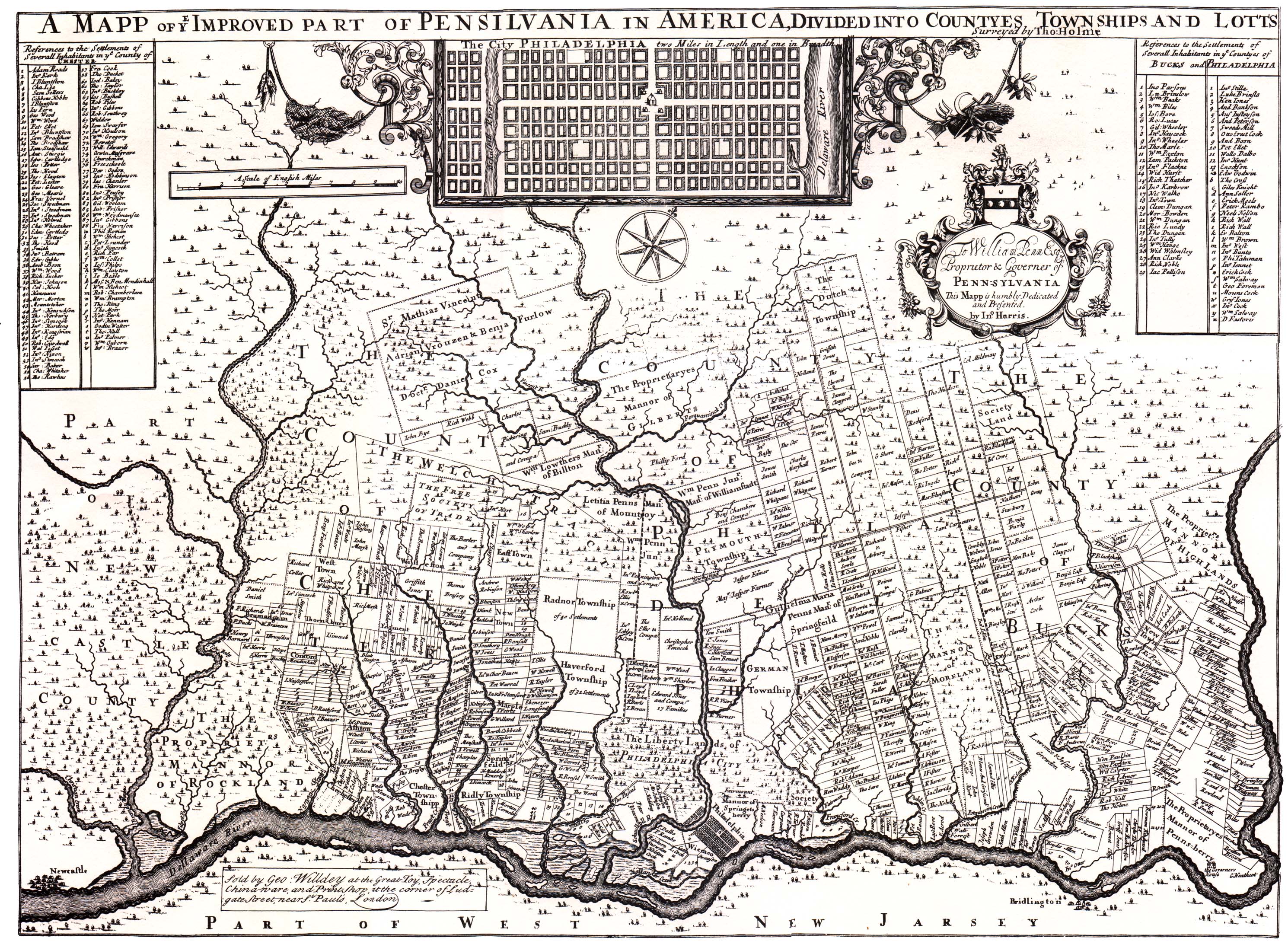
1687 Map of PA Townships
This is a wonderful map of early Pennsylvania! Thomas Willcox did not arrive until about 1718, but we can see the location of the "Welsh Tract" where he purchased land with Thomas Brown in 1727.
http://www.lowermerionhistory.org/atlas/1687.html - Link to the main page for proper credit for the map.
http://www.lowermerionhistory.org/atlas/maps/1687/1687.jpg - Link to the map itself.

http://www.lowermerionhistory.org/atlas/1687.html - Link to the main page for proper credit for the map.
http://www.lowermerionhistory.org/atlas/maps/1687/1687.jpg - Link to the map itself.
Engraving of Ivy Mills

This early engraving of Ivy Mills is found in the collection "Historical Images of Philadelphia." Click on the photo to go to the link of the collection.
Willcox paper and the Bank of North America
The following link shows a photo of a receipt to Mark Willcox for 10,000 sheets of paper. Signed by Jos Pennell in behalf of Robert Morris. Photo from the extra-illustrated version of History of the Bank of North America.
http://www.flickr.com/photos/historicalpa/9358859279/in/photostream/
And this link shows a piece of Willcox-made paper:
http://www.flickr.com/photos/historicalpa/9358859109/in/photostream/
Keep scrolling through the photos!!! This is an absolutely beautiful link to photos taken of items preserved by the Historical Society of Pennsylvania.
http://www.flickr.com/photos/historicalpa/9358859279/in/photostream/
And this link shows a piece of Willcox-made paper:
http://www.flickr.com/photos/historicalpa/9358859109/in/photostream/
Keep scrolling through the photos!!! This is an absolutely beautiful link to photos taken of items preserved by the Historical Society of Pennsylvania.
Thomas Willcox Family mentioned in Proper Philadelphia
Here is a wonderful link about the Thomas Willcox family including a beautiful photo of the house:
http://www.properphiladelphia.com/willcoxes-of-ivy-mills/
http://www.properphiladelphia.com/willcoxes-of-ivy-mills/
Ivy Mills in book 'Old Roads out of Philadelphia'
Ivy Mills is mentioned in the book "Old Roads out of Philadelphia" by John Thomson Faris published in 1917 and found at this Google Books link:
pp. 7-8 of this book list several sources I haven't looked at yet (and that look really great to delve into). Histories, journals, letters, guide books.
pp. 7-8 of this book list several sources I haven't looked at yet (and that look really great to delve into). Histories, journals, letters, guide books.
Ivy Mills photos
There are six photos of Ivy Mills here:
http://www.flickr.com/photos/17957544@N00/
I absolutely can't wait until I travel to PA and take my own... I will probably take 300 or so. :)
http://www.flickr.com/photos/17957544@N00/
I absolutely can't wait until I travel to PA and take my own... I will probably take 300 or so. :)
Newspaper article about Ivy Mills
Phila.'s first Catholic mission still a symbol The Willcox estate has been in the family since the 1720s. Friends of Old St. Thomas seeks funds for renovation.
October 18, 2001|By Kelly Wolfe INQUIRER SUBURBAN STAFF

CONCORD TOWNSHIP — Since 1995, Mark Willcox 3d has been renovating his family's once-grand homestead, a three-story colonial also known as the first Catholic mission in the Archdiocese of Philadelphia.
He estimates that he has already spent "several hundred thousand dollars" to refurbish the 9,500-square-foot home, money he hopes to recover by renting out the building for weddings and social gatherings once his work is complete.
"That's how we hope to keep supporting the place," Willcox said. "Plus, I just want people to see it."
The Willcox Estate has been in the family for eight generations, since the 1720s, when priests traveling to Philadelphia from Maryland stopped to rest and say Mass. That first Mass established the Willcox home as a Catholic mission.
By 1837, the Willcoxes had expanded their home and built inside it a small chapel they called St. Mary's Chapel, which helped to accommodate the traveling priests and a handful of local Catholics who came once or twice a month to worship.
"We feel this site is the physical manifestation of religious freedom," said Marianne Squyres, the president of the Friends of Old St. Thomas, a group that seeks to maintain historic buildings in the area. "It's a place where the idea [of religious freedom] really grabbed hold."
Friends of Old St. Thomas is conducting research on possible grants toward renovation and is trying to spur community support for the project.
At the home, the first and second floors have been refurbished and look new. Hardwood floors gleam, and large windows let sunlight stream in. The third floor, however, has been roped off. There, the dark rooms smell like earth. Old, scuffed floors creak, and broken furniture is stacked all over.
The Rev. Michael J. McNally, a professor of church history at St. Charles Borromeo Seminary, stumbled upon the Willcox estate, and St. Mary's Chapel, in March.
"I had done some study of the Jesuits of Maryland and knew [St. Mary's] was one of the first in Philadelphia," he said. "I'm wandering around, and I get to the house and I didn't think anyone would be home. Well, Mark Willcox 3d was there, and he gave me a tour."
After asking Willcox's permission, Father McNally brought a group of about 30 seminarians to the chapel for Mass. Such a service had not been held in the chapel since the 1850s, when the nearby Catholic church, St. Thomas the Apostle, was erected on land donated by the Willcoxes.
(Page 2 of 2)
St. Thomas the Apostle is considered the first Catholic parish in the Archdiocese of Philadelphia.
Thomas Willcox and his wife, Elizabeth Cole, settled on the property, at Ivy Mills and Polecat Roads in the 1720s, Squyres said.
The family established a thriving paper mill, which would produce paper for Benjamin Franklin's print shop, colonial currency, and the first United States currency.
She said the first Mass in the Willcox home was celebrated about 1720, although the first priest who said this Mass is unknown.
Father McNally said it was not unusual for Catholic priests of that time to saddle up and visit private homes, saying Mass, and spreading the faith.
"They just traveled," he said. "They would go from place to place, sometimes visiting once a year."
The Willcoxes offered an especially attractive venue, he said, because paper mill workers would come to Mass with the family. The more Catholics the priests could visit at one place at one time, the better.
The house has been passed down through generations, although the family always maintained a good relationship with the archdiocese. In the heat of the summer, the young seminarians from St. Charles Borromeo Seminary would vacation there. They also took refuge there during the Know-Nothing riots in the 1840s.
In 1924, the last of the Willcox mills ceased operation. During hard times, the family would take in boarders or sell eggs to keep from selling the home. In time, it fell into severe disrepair. Willcox said, however, that the home had been continuously occupied until renovations began in 1995.
A newly placed historic marker, which stands along the tree-lined drive of Ivy Mills, simply states that "an early Catholic mission was established on the property."
Mark Willcox 3d said he was working to restore both the property of his family and the history of his community. And he wants others to be involved. Only a handful of volunteers have chipped in to help, however, signing their names in felt-tip pen on a wall inside a closet.
"Right now, we're doing it all out of our own pocket," he said.
Kelly Wolfe's e-mail address is kwolfe@phillynews.com.

PHOTO CREDIT: http://www.flickr.com/photos/45509439@N00/3411307953/in/photostream/
Three more beautiful pictures of Ivy Mills at the above link.
Three more beautiful pictures of Ivy Mills at the above link.
Old book mentions Ivy Mills
A short description of Pennsilvania
By Richard Frame, Horacio Gates Joneshttp://books.google.com/books?id=riEUAAAAYAAJ&pg=PP15&lpg=PP15&dq=The+Willcox+Paper+Mill,+1729+-1866&source=bl&ots=C21Fp7tFVj&sig=PaxGXL9g3SDEjBUEF2tp5mq_o8I&hl=en&ei=xEQETcuND9SNnQfWl5jlDQ&sa=X&oi=book_result&ct=result&resnum=6&ved=0CDcQ6AEwBQ#v=onepage&q=The%20Willcox%20Paper%20Mill%2C%201729%20-1866&f=false
A history of paper-manufacturing in the United States, 1690-1916
By Lyman Horace Weeks
Info about Ivy Mills is found on pp. 11-14.
http://books.google.com/books?id=lDghAAAAMAAJ&pg=PA12&lpg=PA12&dq=The+Willcox+Paper+Mill,+1729+-1866&source=bl&ots=BfPMdob3Qe&sig=Xn9p20vv9AAlE2FC_iUxJZ3cvV8&hl=en&ei=xEQETcuND9SNnQfWl5jlDQ&sa=X&oi=book_result&ct=result&resnum=2&ved=0CB4Q6AEwAQ#v=onepage&q=The%20Willcox%20Paper%20Mill%2C%201729%20-1866&f=false

 | |
Three Willcox Paper Mills
Ivy Mills was the first mill, a hand mill, established by Thomas Willcox in 1729. James M. Willcox took over with a knack for progress and leadership and built two more machine driven mills. The Willcox paper was rated as some of the best in the world and they had a worldwide market for their famous product.
 | |
Ivy Mills Paper Mill - With Labels
Thomas Willcox started his paper mill in 1729, the same year his friend Benjamin Franklin started his printing press a few miles away in Philadelphia. Some Willcox descendants made their way down to NC and on to Georgia. These families are still living in the Jacksonville, Georgia (Telfair County) and surrounding areas.
Subscribe to:
Posts (Atom)